
The old photographs are similar to the window to the past, where the previously colorful memories have passed and lost their brightness with passing years. These photos usually narrate the tale of family meetings, birthdays, and things that people can never revisit. However, with the development of technology, we are now at a place where we can use artificial intelligence and save these eternal snapshots. The ai old photo restoration is disrupting the competition these days as it brings hope to people who desire to bring their favorite photos back to life.
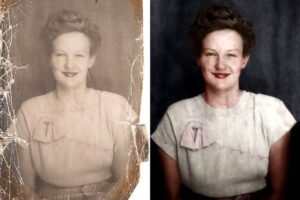
The development of artificial intelligence has travelled a long path since its inception, but today it has spread into other industries that we thought would never be affected by it. One of such areas is photo restoration where AI is shaking things and provides us with the means to repair the damage caused by time and wear. Turning faded hues to lines, marks, and breaks, the AI-based restoration instruments could do more than restoring such images, and this could be giving them a whole new set of colors, a set of colors that were nearly forgotten to exist.
The capability to identify and fill in the missing details in a manner that seems natural is one of the most amazing features of AI old photo restoration. The old way of restoration took hours of handwork, a shrewd eye and a hand which was steady. Now AI is intervening with its supernaturally skilled capability to compute a thousand pixels in a few seconds. It is able to identify at an automatic rate where the photo is damaged and rebuild the lost sections, they are often remarkably organic in their reconstructions. Suppose we have a portrait in which a face has melted away into almost unconsciousness. The missing details can be rebuilt with the magic of AI and the personality of the person can be captured once again.
This is where it becomes interesting, however, the place of emotion. It is not only about recuperating a photo to appear the way it used to be when it was first captured, it is also about keeping the mood behind the photo. Photos are not merely a piece of paper and ink as well; they are a part of our history. It can be a smile of a relative who has not seen you in many years or a snapshot in time, these photos are emotionally rich in more than visuals.
This emotional layer can be accessed by AI, in all its logic and accuracy, by understanding the situation of an image. The AI is able to study the background, the light, and the general mood of the photo with the help of deep learning algorithms. This will enable it to do better than pixel-perfect restoration – it can reproduce the kind of atmosphere taken at that moment. Although it does not necessarily eliminate the human touch, AI can provide a new angle of restoration to photos.
Colorization is one of the areas in which this tech comes out the best. We have been years admiring the black-and-white photos because of their vintage appeal, and now AI can make them colorful, providing a more substantial experience of the past life. The colors are not simply guessed, but data-driven models, which knew how light, cloth, and skin tones would have appeared at the moment. What used to be lifeless black and white photo turns out to be a colorful recollection. Not only is it a restoration of the original feel to the image, but it also gives it a sense of genuineness and comfort as well.
Though the old photo restoration using AI is quite impressive, it is not devoid of challenges. Still, there is a thin line between maintaining the integrity of an image and improving it. In some cases, a hyperactive AI can flatten wrinkles that do not need to be removed or misunderstand the fashion of an era, which is something that does not fit. That is why human expertise is not yet eliminated. It is the combination of technology and human imagination that makes AI old photo restoration so exciting as a frontier.
In the future, it appears that the uses of AI in restoring old photos will have no limits. As the machine learning progresses, it might be possible to have AI that is capable of operating with a broader variety of damaged photos, repairing them with even greater accuracy in the future. An example would be old photos that used to be considered as irretrievable due to their excessive breakage or even due to age could be re-created with exceptional details. It might even come to the point that the AI will be able to re-construct whole scenes out of fragmented images, and recreate parts of the image that are missing, and connect the pieces back together to create a coherent and emotionally valid representation of reality.